Monday, March 25, 2013

Ángel Ganivet, Pío Cid, Suicide


In late November of 1898, the Spanish writer Ángel Ganivet, consul at Riga, twice threw himself into the freezing waters of the Dvina (he was fished out the first time, but, perhaps somewhat ungratefully, he jumped right back in, and this time there was nothing doing). He was not yet thirty-three.
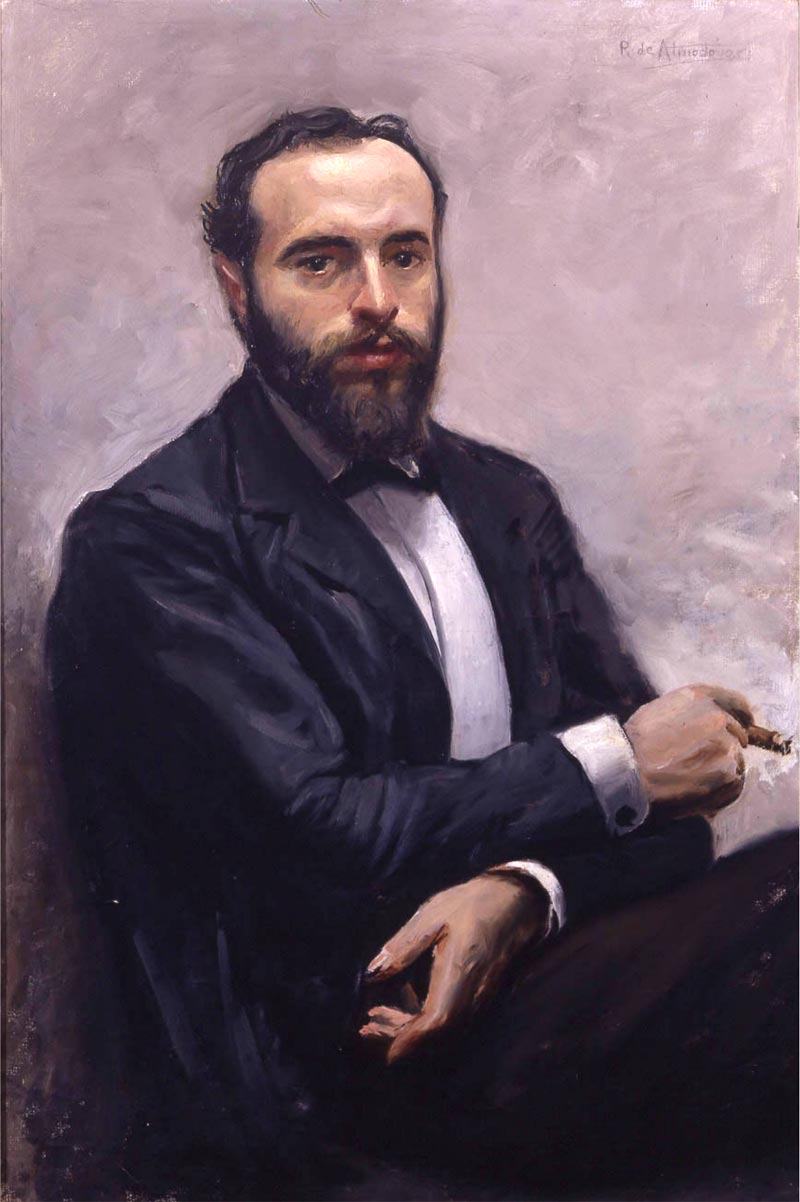
Ganivet, by José Ruiz de Almodóvar


The very year of his suicide, Ganivet had published (self-published, in fact) an extraordinary book, Los trabajos del infatigable creador Pío Cid, whose main character, Pío Cid, is an eccentric clearly modeled after Ganivet himself. Though Pío Cid is never less than intriguing, he is perhaps not always as witty or brilliant or selfless as his tireless creator Ganivet seems to think he is. For that reason, then, when Judith Ginsberg, in her book on Ganivet, examines the possible reasons for his suicide, the following remarks do not seem out of place:
The persistent association of Pío Cid and Jesus Christ strongly suggests a pathologically grandiose self-image which would be in keeping with Utrillo's impressions of Ganivet when the two of them met in Barcelona in the late summer of 1897. Such an omnipotent self-image would be impossible to maintain and the inability, failure, or perceived refusal of the outside world to support such a self-image has long been associated with suicide attempts in neurotically depressed people.

Pío Cid's self-image (and thus Ganivet's) does indeed seem disproportionately grandiose at times. All the same, on reading Ganivet's delightful work, one also wonders if, in his case, the larger world, by refusing to recognize his brilliance, did not penalize itself most of all. It can be of little comfort to him, of course, but 115 years after he drowned himself in the Dvina Ganivet has found at least one reader, from a country different from his own, for whom translating his work is a delight and a consolation and perhaps even an act of revenge.

Nuto Revelli in English

Mussolini's Death March: Eyewitness Accounts of Italian Soldiers on the Eastern Front, a translation of Nuto Revelli's La strada del davai, is the first of Revelli's books to appear in English. It won't be the last.

Sunday, September 2, 2012

Latest Translations

One's recent translations include a charming comedy by Marivaux, a short novel and a story by Federico De Roberto (The Wedding Mass and "The Rosary"), two short stories by Italo Svevo ("Death" and "Argos and His Master"), and one by Machado de Assis ("A Fire"). All are available--or will be very shortly--on the usual bookselling sites. Next up? Maybe Ganivet. Maybe more Machado, more Wedekind, more Stendhal (Mémoires d'un touriste?). Maybe nothing at all.

Friday, August 31, 2012

Julio Ramón Ribeyro, 31 August 1929

Julio Ramón Ribeyro would have turned 83 today. Nearly twenty years after his death, however, his work is no better known in the English-speaking world than it was when he died (Ribeyro's books are constantly being re-issued in his native Peru, a collection of his essays is being republished in Chile, and publishers in both Brazil and Portugal have recently brought out solid collections of translations of his stories; it is the United States and Britain that, as always, are lagging badly).

For Peruvians, Ribeyro is a beloved figure; other than the obvious (his work is superb), it's hard to say exactly why, but one reason, perhaps, was his modesty: he was seemingly unaware of his own greatness.

Tuesday, July 24, 2012

The Absentminded Caress

Text 138 of Julio Ramón Ribeyro's Prosas apátridas:

For ten years, when I worked at Agence France-Presse, I went almost every day to the gardens of the Palais-Royal to walk around the galleries for a few minutes before or after lunch and, when I had no money, instead of lunch. And what is left in me of all those walks, good God, what is left? What good was that investment of hundreds and hundreds of hours of my life? Good for nothing, except to leave in my memory something like a foolish image of postcard-like precision. We have the idea that our lives have goals and we think that all our acts, especially those that are repeated, have some hidden meaning and must bear fruit. But that's not the way it is. Most of our acts are useless, sterile. Our lives are woven in a gray and flat weave and only here and there does a flower or a design suddenly emerge. Maybe our only valuable and fertile acts are the gentle words we sometimes utter, a bit of boldness, an absentminded caress, the hours spent reading or writing a book. And nothing more.

Confessions of a Journeyman Typesetter

Confessions of a Journeyman Typesetter is Gérard de Nerval's biography of the French author, printer, and libertine Rétif de la Bretonne, whose work the 1911 Britannica deems "unfit for general perusal."
Rétif de la Bretonne

It is a history of an eighteenth-century literary life, a life that, with its book pirates, self-promoters (Rétif, a printer by trade, not only published his own work but also publicized and printed it), crooked publishers, hyperinflated reputations, and other assorted features, will not seem altogether unfamiliar to observers of contemporary literary life. The English version is available only as an ebook and can be found on the usual online bookselling sites.

Sunday, July 22, 2012

Pla, the Rhapsody, and the Moonlight Sonata: El Canadell


Music plays a certain part in my childhood memories of El Canadell.
At the time, the instrument considered most effective at getting people to dance, and the most widely used one, was the barrel organ. But this contraption and its metallic and rustic notes didn’t imprint themselves on my memory: they have left in my nose the unpleasant smell of the gas lamps that lit outdoor dances.
 All the same, in El Canadell there was something of good quality: the Genover family’s piano. It was played by the two older siblings of the family—usually with four hands: Maria and Xicu. On very still days—in the terrible morning sun or at sunset, in the gentle half-light—you could hear the piano from a long way away, and in El Canadell a kind of abeyance was occasioned: the people who were going by the Genover place automatically tended to start walking on tiptoe.
Maria and Xicu would sit at the piano. Seen from afar—they played in a ground-floor parlor that had a big window facing the street—they looked like two automatons. They played stiffly and as if corseted. They were fans of select music. Maria, in addition to the playing piano, sang vaporous, sentimental ballads. Xicu, with the practice book in front of him, never tired of doing finger exercises. Cheap music is usually enjoyable, and it’s surely for that reason that those who cultivate it tend to make too great a show of it. Those who play select music are more closed to things, more difficult, and fussier. But Xicu and Maria—or Maria and Xicu—didn’t need as much persuading as corresponded to the notes they played. When an acquaintance came up to them with a friendly and pleasant look and said to them, “Oh, Xicu (or Maria), play the Rhapsody! It’s so pretty,” you contemplated the reassuring sight of seeing them—no matter how little free time they had—go over to the piano, sit down in front of the keys, open the music book, and play Liszt’s Hungarian Rhapsody No. 2. Before beginning, they looked at each other to confirm their cooperation in the performance: a serious look that turned into a weighty smile. Complete silence fell over the parlor. Everyone was concentrating. Everyone was making that face of feigned suffering that people are in the habit of making before refined music. And from the piano, with a brilliance slightly diminished by petty-bourgeois taste, came Liszt’s Hungarian Rhapsody No. 2.
This piece was quite the undertaking. It was hard to play. The furious parts gave the people—so they said—gooseflesh. But in the more contemplative moments—which perhaps coincided with an audience of greater refinement, an audience that made faces of solemnity rather than of suffering—there was another great piece: Beethoven’s Moonlight Sonata. If the Rhapsody was a work for fingers and vigor, the Moonlight Sonata was a piece for feeling. Together they made a complete musical microcosmos.
In this way, I, as a teenager in El Canadell, found myself literally saturated with the Rhapsody and the Moonlight Sonata. And there’s nothing to be done about it now: this is the select music that will waft in my memory of those days for the rest of my life. It’s the music that will bind me to El Canadell for as long as I live—as I am bound to it by a distinctive smell, very sweet, of rice powders and patchouli, a taste for roast mullet with oil and vinegar, the novels of Paul Bourget, and the form—barely glimpsed—of the calves of a few hazy, indistinct young ladies of the time.
--Josep Pla, El quadern gris