"The
only civilized people on the beach at Albufeira are those peasants who, dressed
in black in the torrid sun, with their odd way of wearing their hats,
pulled far down over their eyes and raised above the nape of the neck,
sometimes descend from their plots of fig and almond trees and stand gazing in
slightly astonished silence, but with dignity and indulgence and wisdom, at the
tourists who, disguised as frogs skinned alive in the glare, surrounded by bags
of towels, greased like firearms, have disembarked from moving vehicles come
from the north and are now baking on the sand, reading Die Welt, The Times, Le Monde, and introducing into that beautiful
place, unawares, the first signs of barbarism."
--Julio Ramón Ribeyro, Prosas apátridas
Thursday, July 5, 2012

Tuesday, June 12, 2012
Léautaud, Pla, Ribeyro
 |
| Paul Léautaud |
Verses are clearly a childish thing. People who write things in rhythmic patterns, to particular beats, each line ending in similar sounds, that singsong of a child's reciting--at bottom, it's ridiculous. I've thought for a long time that if I had a son and he had a literary bent or even an inclination for the life of the mind I'd keep all the poets from him, even though I don't like being a guide in that field. Those people cause you to waste a lot of time when it comes to the development of the mind. I wasted at least fifteen years letting myself be lulled by their nonsense. And the novel? How can a man, at fifty, still write novels? How can a person even read them? Poetry and novel--they are certainly the lower forms of literature.
Léautaud also makes several appearances in Julio Ramón Ribeyro's La tentación del fracaso, yet another excellent diary not available in English (it is published in Spanish through 1978; the diaries from later years, still only in manuscript, are being held in a bank vault in Paris). Ribeyro, perhaps not surprisingly, refers to Léautaud's "atrocious" death, which he approached with complete lucidity and surrounded by a menagerie of animals. Foutez-moi la paix, he supposedly said on his deathbed. Leave me the fuck alone.
Stendhal, Wedekind, and Others
One keeps forgetting to plug one's more recent translations (the purpose of this blog, after all). They are available as ebooks on most of the usual online bookselling sites. Authors translated include Stendhal, Marià Vayreda, Leopoldo Alas, Federico De Roberto, Joaquim Maria Machado de Assis, Heinrich Mann, and Frank Wedekind.

The Catalan Vayreda seems never to have been translated into English before; on looking up Wedekind to see what English translations of his work had been published, one is somewhat surprised to find oneself in what one might not have been inclined to consider good company. Oh well.
Soon to be published are English translations of Marivaux's play Les Fausses Confidences and of Nerval's Les Confidences de Nicolas (on the eighteenth-century libertine and printer Rétif de la Bretonne, whose books the 1911 Britannica encyclopedia describes, not altogether inaccurately, as "unfit for general perusal.")


Wednesday, June 6, 2012
Three Easy Pieces
Three prose pieces from Julio Ramón Ribeyro's Prosas apátridas:

48
At
uncommon moments my gaze acquires an intolerable sharpness and my mind a power
of penetration that frightens me. Everything becomes a sign, an omen. Things
stop being what they seem to be to become what they probably are. The friend
I'm talking to is a clothed animal whose words I barely understand; the
Monteverdi song I'm listening to, the sum of all melodies invented up to now;
the glass I have in my hand, an object offered me, over the centuries, by
Stone-Age man; the car crossing the square, the dream of a Sumerian warrior;
and even my poor cat, the messenger of knowledge, temptation, and catastrophe.
Everything loses its innocence to become what it hides, germinates, or means.
These moments, unbearable, all you want to do is close your eyes, cover your
ears, abolish thought, and fall into shoreless sleep.
49
The
surprise--indeed, the terror--I felt as I saw the agency employee, with his
withered arm, that one arm shorter than the other, topped off with a hand not a
hand but a kind of stump with fingernails, threaten the waiter at the bar. I
realized just then that the extremity I considered his weakness, and which I
pitied him for, was his customary tool of aggression.
52
Facing
forward or facing backward in a moving train: the amount of country you see is
the same, but the impression you get from it is so much different. Those who
travel facing the right direction feel as if the country were being thrown
forward toward them or, rather, as if they were getting thrown forward toward
the country; those traveling facing backward feel as if the country is fleeing
them, becoming lost to sight. In the first instance, the traveler knows he's
approaching a place, whose proximity he senses with each new fragment of space
that appears before him. In the second, he knows only that he is moving away
from something. Likewise, in life, some people seem to travel facing backward:
they don't know where they are going, what's awaiting them, everything evades
them, the world that others take in with a forward-looking act of perception
is, for the former, nothing more than flight, residue, loss, defecation.
Monday, April 9, 2012
Josep Pla, Cherries, and Sparrows
Cherry trees haven't set fruit yet--it's too early--but it's hard to resist posting a brief entry, premature though it may be, from Josep Pla's El quadern gris. It is dated 19 June 1918:

A delicious combination these June days: desserts based on cheese and cherries. The taste of cheese and that of cherries are, in my opinion, complementary on the palate. Too bad that the cheese in this country is so tasteless and mediocre. The best cherries aren't the first ones, the blanquelles, but the firm red ones with dense flesh that we call heart of dove or matapedra. The ones slightly pecked by the beak of a sparrow are especially delicious.
Wednesday, April 4, 2012
Story of No Return No. 2
Story of No Return No. 2
Mario Levrero
A dog,
Campeón. I lived alone with him and at some point he started bothering me. I
took him to the forest, left him tied up with a cord that he could break with a
little perseverance, and went back home.
A
couple of days later I had him scratching at the door; I let him in.
He
became unbearable; I took him to a more distant forest and tied him to a tree
with a stronger cord (I knew that the flaw was not in the cord but in the
animal’s loyalty; perhaps I had the secret hope that this time he wouldn’t get
loose and would die of hunger).
A few
days later he came back.
I
realized then that the dog would always come back; for fear of pangs of guilt,
I didn’t dare kill him; and I thought that even if I managed to lose him, in a
forest more distant still, I would live with the constant fear of his return;
it would torment my nights and cloud my joys; his absence would tie me up more
than his presence.
For
barely a second, then, I hesitated before majesty of the dense forest—shadowy,
imposing, unfamiliar—rising before my eyes; resolutely, I began going into it,
and I went in deeper and deeper until, finally, I got lost.
Wednesday, March 7, 2012
Fan Mail
In her late teens, Marie Bashkirtseff wrote a letter to one Monsieur de M. Thus began a brief (Baskhirtseff died in 1884, shortly before her twenty-sixth birthday) but lively correspondence between the Ukraine-born mondaine and Guy de Maupassant.
Only shortly before her death did Maupassant discover the identity of the correspondent who tells him in her first letter that she will always remain anonymous:
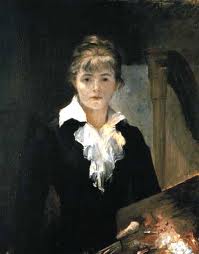 |
| Self-portrait of Marie Bashkirtseff |
Only shortly before her death did Maupassant discover the identity of the correspondent who tells him in her first letter that she will always remain anonymous:
Monsieur,
I read you almost with happiness. You adore the truths of nature and find a truly great poetry in them, all while stirring us with details of feelings so deeply human that we recognize ourselves in them and love you with a selfish love. Is that a flowery remark? . . . Be forgiving—the essence is sincere.
I’d obviously like to say exquisite and striking things to you, but it’s very hard, just like that, right now. . . . I regret it all the more in that you are exceptional enough for a person to dream very romantically of becoming your beautiful heart’s confidante, if indeed your heart is beautiful.
If your heart isn’t beautiful and if you “aren’t into that sort of thing,” I regret it most of all for you and then I’ll call you a manufacturer of literature and that would be it.
It’s been a year now that I’ve been about to write you, but . . . several times I thought that I was overrating you and that it wasn’t worth it. When, all at once, two days ago, I read in the Gaulois that someone sent you a gracious letter and you ask for this good person’s address to answer him. . . . I got very jealous right away—your literary merits dazzled me again, and here I am.
Now, listen closely to me, I will always remain anonymous (really) and I don’t want even to see you from afar—who knows? I might not like your looks. I know only that you are young and that you aren’t married, two essential points even in the blue of the clouds.
But I’ll have you know that I’m charming—this delightful thought will encourage you to answer me. It seems to me that if I were a man I would want no commerce, not even epistolary, with an old English hag, regardless of what might think
Miss Hastings.
R.D.G. (Bureau de la Madeleine)
Subscribe to:
Posts (Atom)