Friday, February 21, 2014

La cosa en sí


La cosa en sí is the second of the three volumes of Andrés Trapiello's multi-volume diary that, to my surprise, I found in a bookstore in the city I was living in in France, a city whose inhabitants, for the rest, have almost no interest in things Spanish. If I didn't enjoy this volume quite as much as the first one I read, El jardín de la pólvora, it's just that the earlier volume had already prepared me: I expected to be entertained and astonished. With the earlier volume, it had come as a complete surprise.

As with El jardín, I particularly enjoyed Trapiello's bitchy, gossipy, and perhaps even slightly malicious but surely accurate portrayals of his fellow Spanish writers. He coincides with Enrique Vila-Matas at the famous book fair in Guadalajara, Mexico, for example. Vila-Matas isn't named, but he's clearly recognizable even to someone like me, who is by no means in the loop. Trapiello describes him rather acidly (he calls him the man whose stock response, unlike Bartleby's, would be: "I would prefer to") and stresses his physical resemblance to Buster Keaton. I was most gratified, as I've never enjoyed Vila-Matas's books, and his relative popularity baffles me. Vila-Matas's books, for instance, have been translated into English; not so Trapiello's, which, on the strength of the two I've now read, are more interesting and much funnier, at least to me.

At another point, in Colombia, Trapiello refers to the Colombian artist Botero as the current darling (the diary corresponds to the year 2000) of the PUB (Pedorrez Universal Burguesa). I laughed out loud there. Of course, that laughter may have been in part the result of the single apéritif that I, in utter solitude, had just consumed.

But good Lord God, since we're obviously not going to translate him, contemporary English-language writing needs someone with Trapiello's lucidity, his corrosive humor and caustic spirit, his independence and courage! Instead we have J. Franzen and P. Roth. We have Lorrie Moore and Louise Erdrich and Joyce Carol Oates. We have critics who, as E. Abbey used to say, are like giant schools of minnows, all turning in the same direction at once. We translate Enrique Vila-Matas.

There are some things in the diary I don't really like, too. For Trapiello, everything that's attractive or appealing becomes precioso. I've never really liked that word in either Spanish or English. All the writers he discusses are referred to either as X or by their initials. I don't really get it. Sometimes you can identify these writers easily enough (as with Mr. I Would Prefer To), but other times it's hard. Here, Trapiello praises the stories of one D.J., a Colombian (?) writer who works for the Banco de la República and lost a leg to a bomb. I might have liked to try these stories for myself. But who is this writer? Finally, Trapiello sometimes launches into brief flights of fancy (never more than two or three pages) that sometimes strike me as a bit too fanciful. Are his novels made up of successions of such passages? If so, I'm not sure I'd enjoy them.

At all events, one has one more volume of the diary to read, and after that one will decide where to go: to one of the novels or back to one of the earlier volumes of the diary.

Sunday, February 2, 2014

Paper Wings and Baseball


Getting back to Bukowski, why is it that in a country such as ours [Peru] a writer like him never appears or appears only most rarely? I mean a writer who writes with “his guts,” whatever comes to mind, in the most direct, brutal, and vulgar way, without any self-censorship (saying Nixon is a piece of shit, Bernard Shaw a cretin, Genet a little woman, Shakespeare a bore, and so on), without the slightest pretension of the man of letters or the subtle thinker, and without accepting any convention (literary, moral, civic, and so on)? It’s apparently inexplicable. It could be explained that it would be difficult for a writer of this sort to emerge in France, for example, because it’s a country with a pure literary tradition, where whoever devotes himself to writing already has all the models in his head and has had rhetoric beaten into him since elementary school and has also received a language chewed over or refined over centuries of collective work and with which it’s difficult to do anything new. This is not the case in Peru, where it’s theoretically possible to get to literature (to write) by non-established or uncommon ways, which would permit Bukowskian forms of writing. The reasons for this phenomenon are complex. Several come to mind: literature in Peru is reserved for the élite, for people who have been to university, with all that that implies. Whoever hasn’t been to university or at least high school doesn’t write simply because he’s never learned to read and write. The U.S., on the other hand, allows for the assimilation of literature and a cultural apprenticeship outside the confines of school. Besides that, there’s another element: the lack of roots. No matter how underdeveloped Peru may be, its population is more deeply rooted in society, through misery, mediocrity, prosperity, or riches. We don’t have that demographic mass of immigrants or children of not yet integrated immigrants who are looking for cultural roots and, unable to claim any, are freer. All this is horribly explained. But I understand myself and that’s what matters to me now. In our environment, a Bukowski-type literature has no ticket, because before starting out to write you have to have learned a lot of things, among them belles-lettres and other idiocies. There’s neither a place nor an audience for those on the margins of these standards. With us, everybody wants to “write well,” to show, to prove that things can be done as well as or better than in other places. Dependence, imitation, performance. The writer has to be knowledgeable, clever, know it all, be a show-off. One writes par rapport à other literatures or a certain commonly accepted notion of literature rather than par rapport à oneself. 

With what I say here I’m not defending Bukowski’s literature, not at all. It’s fine with me if people write that way, but also in another way. I in any case—who will never attain a fraction of B.’s audience—will never write that way. For the reasons I’ve mentioned and for others. What Bukowski writes is impressive, but reading him exhausts you. There’s no more than what’s said. His discourse fits precisely over his meaning. There aren’t those fissures, the unsaid, that which is silenced or repressed, the merely insinuated, which to me give writing its breadth and its meaning. Also, no desire for transcendence, to rise above instinct, above the immediate, the bestial, the ordinary. The beefsteak in your face and that’s it. We all know that man is a beast, as Pascal said, but he also said that he’s an angel. B.’s angel has paper wings and plays baseball. I don’t believe in angels with paper, flesh, or aluminum wings, but I do believe in the need to soar over the vulgar when writing and to seek something other than the hyper-realistic summary of our much too familiar miseries.

--Julio Ramón Ribeyro, La tentación del fracaso (26 September 1978)

Monday, January 27, 2014

Mood Swings


Paris, 22 July 1964
 
Our states of mind are so fragile. How little it takes (the sky going cloudy, seeing a pretty woman go by, or simply lighting a cigarette or letting a memory come to the surface) to go from discouragement to optimism or vice versa. The whole color of life changes. All morning and most of the afternoon I was gloomy, pensive, leafing through my novel, finding only flaws not just there but also in my life, telling myself: “Decrepitude has begun.” I even wrote to my brother to let him know some of my thoughts on the matter. At dusk I looked out the window facing rue de Bagnolet and I thought something, something imprecise I couldn’t recall now, but when I went back to my desk I was happy, surer of myself, telling myself, “I’m not just anything, I am worth something, I do things well, but slowly.” Now, as I write this, my enthusiasm—a very grandiloquent word, something less than enthusiasm—continues and I confront this evening, and as a result, all those to come, with confidence. But who can assure me that this will last? The fact of having looked at my ashtray and counted more than thirty butts there, the remains of a single, unfinished day, frightens me a bit, begins perhaps to harm my serenity. Alida out buying dinner. Maybe when she comes back she will find me disheartened again.

--Julio Ramón Ribeyro, La tentación del fracaso (The temptation of failure)

Wednesday, December 4, 2013

Nineteen Years Without

Peruvian Julio Ramón Ribeyro, one is reminded, died nineteen years ago today. Nineteen years! One stumbled across his superb work very shortly before his death, which one wasn't made aware until years later, on opening a book of essays and, with a shock, seeing the dedication: To Julio Ramón Ribeyro. In memoriam.

In Ribeyro's honor, then, and for the readers (crackpots both, one imagines) of one's infrequently updated blog, text 115 of Prosas apátridas: 

My black cat and I, this rainy summer night. The silent room. Now and then a car slips by on the wet street. The neighborhood is asleep, but my cat and I are still awake, I, at least, reluctant to call it a day without having done anything to justify it, to give it meaning, and to make it different from others just as stinting and empty. Maybe that's why I write pages like this one, to leave tokens, light traces of days that deserve to figure in no one's memory. Time is threaded through every one of the letters I write, my time, the weave of my life, which, like the figure in the carpet, others will decipher.

Monday, November 25, 2013

Gaya on Galdós

Spanish painter and writer Ramón Gaya (for an introduction to whom one is indebted to Andrés Trapiello and his excellent diaries, published under the collective title Salón de pasos perdidos) on Galdós:
Gaya, by Juan Ballester


Galdós I imagine taking one turn after another around Madrid, without haste, to be sure, but not after the fashion of the promenader or the flâneur or with the flâneur’s cynicism; rather, with that stray dog’s gait that is wisdom more exactly than it is slowness; after all, what might come across as vagueness of objective in stray dogs is nothing other than wisdom, profound wisdom, the conviction that there are no absolute places to betake oneself to. Galdós, with his overcoat and scarf, looked like a high-class beggar, a beggar who doesn’t beg, who gets everything without begging; and little by little reality gave itself over to him cordially, without violence, without conquest, without study. Flaubert (certainly a great artist, but less chosen) has such a studious attitude before reality that it often flees, flees offended to give itself over to someone else, someone who, rather than observing it as a phenomenon, treats it as a friend, as a brother; treating reality as an equal—that is, without servility or haughtiness and, of course, without objectivity, without the insult of objectivity—is Galdós’s secret. Galdós sees the most surprising, most monstrous, most unlikely events with great naturalness because, instead of striking the coarse pose of the observer of a spectacle, he offers to be a friend to those events—not to get involved, to take sides, since that would be butting in where he’s not wanted—he offers to be a fellow creature of reality’s to keep it from feeling forsaken or observed. It’s not that Galdós mingles with and gets lost in reality; instead, he makes common cause with it without getting involved in it, and once this common cause is made, once they have become brothers, nothing about this reality can surprise him. It’s easy to identify two attitudes in the great novelists, that of the objective scoffer—Stendhal—and that of the generous wreck—Dostoyevsky—but it’s hard to find a compassionate attitude like Galdós’s. Flaubert thought he was la Bovary, but the thing isn’t being the characters on the inside or gazing on them from afar; the thing is cohabiting with them, approaching them without passion or expediency. Now, after several foolish remarks from 1898 about Galdós, it seems that he is beginning to win favor again, but the researchers, historians, and critics—as always—are digging laboriously through the material of his novels and weighing and measuring the prose, the style, the composition, the accuracy, the imagination, and the symbols without understanding that while they are giving themselves over to this shortsighted work, his greatness is escaping them. We will find Galdós’s greatness not in the composition or content of his novels but in the harmonious relationship miraculously created between him and Reality.

Recent Translations

From Catalan: Narcís Oller's "The September Revolution" and "Novena for the Dead"; Robert Robert's "The Back Room"

From German: Heinrich von Kleist's "Anecdote from the Last Prussian War" and "Betrothal in Santo Domingo"; Frank Wedekind's "The Vaccination"

From Portuguese (Brazil): Joaquim Maria Machado de Assis's "Coimbra the Clerk," "The Diplomat," "Sooner the Tarpeian Rock," "The Pale Woman," "Nameless Flower," "Holidays," "A School Story," "Trio in A Minor," and several others, many not previously available in English


Monday, March 25, 2013

Ángel Ganivet, Pío Cid, Suicide


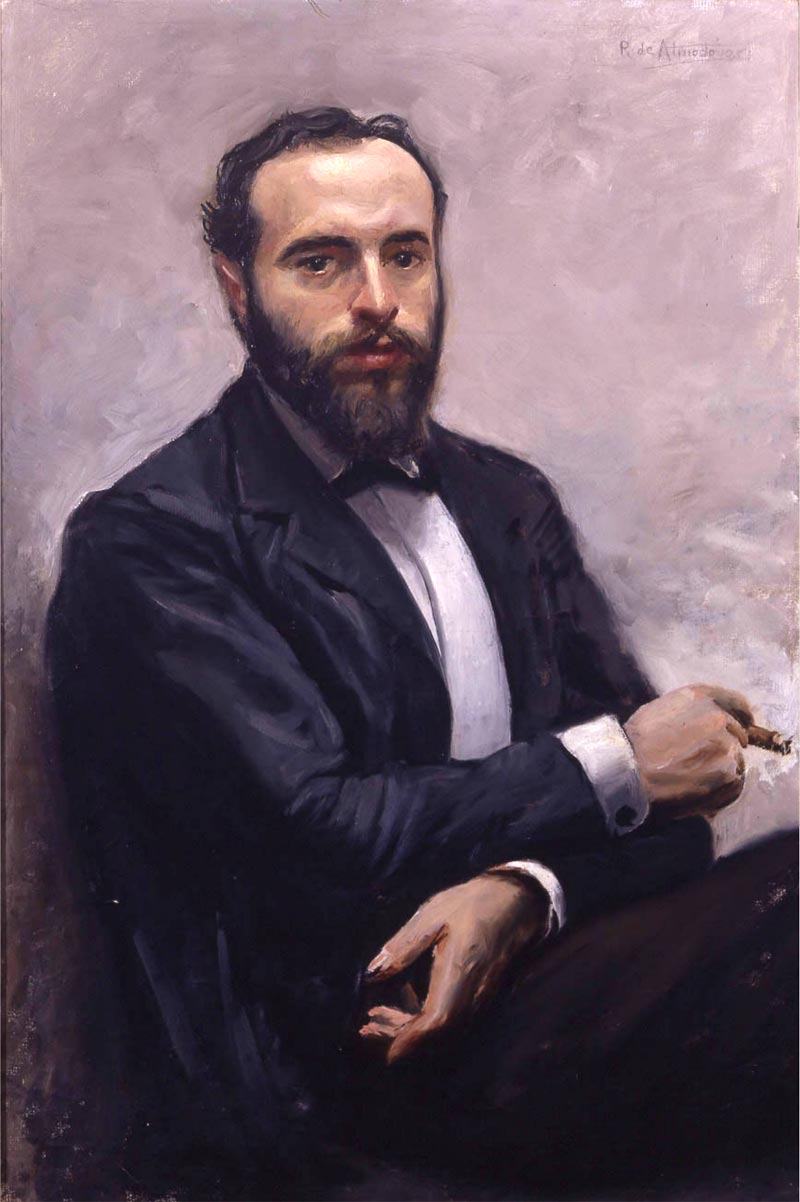
In late November of 1898, the Spanish writer Ángel Ganivet, consul at Riga, twice threw himself into the freezing waters of the Dvina (he was fished out the first time, but, perhaps somewhat ungratefully, he jumped right back in, and this time there was nothing doing). He was not yet thirty-three.
Ganivet, by José Ruiz de Almodóvar


The very year of his suicide, Ganivet had published (self-published, in fact) an extraordinary book, Los trabajos del infatigable creador Pío Cid, whose main character, Pío Cid, is an eccentric clearly modeled after Ganivet himself. Though Pío Cid is never less than intriguing, he is perhaps not always as witty or brilliant or selfless as his tireless creator Ganivet seems to think he is. For that reason, then, when Judith Ginsberg, in her book on Ganivet, examines the possible reasons for his suicide, the following remarks do not seem out of place:
The persistent association of Pío Cid and Jesus Christ strongly suggests a pathologically grandiose self-image which would be in keeping with Utrillo's impressions of Ganivet when the two of them met in Barcelona in the late summer of 1897. Such an omnipotent self-image would be impossible to maintain and the inability, failure, or perceived refusal of the outside world to support such a self-image has long been associated with suicide attempts in neurotically depressed people.

Pío Cid's self-image (and thus Ganivet's) does indeed seem disproportionately grandiose at times. All the same, on reading Ganivet's delightful work, one also wonders if, in his case, the larger world, by refusing to recognize his brilliance, did not penalize itself most of all. It can be of little comfort to him, of course, but 115 years after he drowned himself in the Dvina Ganivet has found at least one reader, from a country different from his own, for whom translating his work is a delight and a consolation and perhaps even an act of revenge.

Nuto Revelli in English

Mussolini's Death March: Eyewitness Accounts of Italian Soldiers on the Eastern Front, a translation of Nuto Revelli's La strada del davai, is the first of Revelli's books to appear in English. It won't be the last.

Sunday, September 2, 2012

Latest Translations

One's recent translations include a charming comedy by Marivaux, a short novel and a story by Federico De Roberto (The Wedding Mass and "The Rosary"), two short stories by Italo Svevo ("Death" and "Argos and His Master"), and one by Machado de Assis ("A Fire"). All are available--or will be very shortly--on the usual bookselling sites. Next up? Maybe Ganivet. Maybe more Machado, more Wedekind, more Stendhal (Mémoires d'un touriste?). Maybe nothing at all.

Friday, August 31, 2012

Julio Ramón Ribeyro, 31 August 1929

Julio Ramón Ribeyro would have turned 83 today. Nearly twenty years after his death, however, his work is no better known in the English-speaking world than it was when he died (Ribeyro's books are constantly being re-issued in his native Peru, a collection of his essays is being republished in Chile, and publishers in both Brazil and Portugal have recently brought out solid collections of translations of his stories; it is the United States and Britain that, as always, are lagging badly).

For Peruvians, Ribeyro is a beloved figure; other than the obvious (his work is superb), it's hard to say exactly why, but one reason, perhaps, was his modesty: he was seemingly unaware of his own greatness.

Tuesday, July 24, 2012

The Absentminded Caress

Text 138 of Julio Ramón Ribeyro's Prosas apátridas:

For ten years, when I worked at Agence France-Presse, I went almost every day to the gardens of the Palais-Royal to walk around the galleries for a few minutes before or after lunch and, when I had no money, instead of lunch. And what is left in me of all those walks, good God, what is left? What good was that investment of hundreds and hundreds of hours of my life? Good for nothing, except to leave in my memory something like a foolish image of postcard-like precision. We have the idea that our lives have goals and we think that all our acts, especially those that are repeated, have some hidden meaning and must bear fruit. But that's not the way it is. Most of our acts are useless, sterile. Our lives are woven in a gray and flat weave and only here and there does a flower or a design suddenly emerge. Maybe our only valuable and fertile acts are the gentle words we sometimes utter, a bit of boldness, an absentminded caress, the hours spent reading or writing a book. And nothing more.

Confessions of a Journeyman Typesetter

Confessions of a Journeyman Typesetter is Gérard de Nerval's biography of the French author, printer, and libertine Rétif de la Bretonne, whose work the 1911 Britannica deems "unfit for general perusal."
Rétif de la Bretonne

It is a history of an eighteenth-century literary life, a life that, with its book pirates, self-promoters (Rétif, a printer by trade, not only published his own work but also publicized and printed it), crooked publishers, hyperinflated reputations, and other assorted features, will not seem altogether unfamiliar to observers of contemporary literary life. The English version is available only as an ebook and can be found on the usual online bookselling sites.

Sunday, July 22, 2012

Pla, the Rhapsody, and the Moonlight Sonata: El Canadell


Music plays a certain part in my childhood memories of El Canadell.
At the time, the instrument considered most effective at getting people to dance, and the most widely used one, was the barrel organ. But this contraption and its metallic and rustic notes didn’t imprint themselves on my memory: they have left in my nose the unpleasant smell of the gas lamps that lit outdoor dances.
 All the same, in El Canadell there was something of good quality: the Genover family’s piano. It was played by the two older siblings of the family—usually with four hands: Maria and Xicu. On very still days—in the terrible morning sun or at sunset, in the gentle half-light—you could hear the piano from a long way away, and in El Canadell a kind of abeyance was occasioned: the people who were going by the Genover place automatically tended to start walking on tiptoe.
Maria and Xicu would sit at the piano. Seen from afar—they played in a ground-floor parlor that had a big window facing the street—they looked like two automatons. They played stiffly and as if corseted. They were fans of select music. Maria, in addition to the playing piano, sang vaporous, sentimental ballads. Xicu, with the practice book in front of him, never tired of doing finger exercises. Cheap music is usually enjoyable, and it’s surely for that reason that those who cultivate it tend to make too great a show of it. Those who play select music are more closed to things, more difficult, and fussier. But Xicu and Maria—or Maria and Xicu—didn’t need as much persuading as corresponded to the notes they played. When an acquaintance came up to them with a friendly and pleasant look and said to them, “Oh, Xicu (or Maria), play the Rhapsody! It’s so pretty,” you contemplated the reassuring sight of seeing them—no matter how little free time they had—go over to the piano, sit down in front of the keys, open the music book, and play Liszt’s Hungarian Rhapsody No. 2. Before beginning, they looked at each other to confirm their cooperation in the performance: a serious look that turned into a weighty smile. Complete silence fell over the parlor. Everyone was concentrating. Everyone was making that face of feigned suffering that people are in the habit of making before refined music. And from the piano, with a brilliance slightly diminished by petty-bourgeois taste, came Liszt’s Hungarian Rhapsody No. 2.
This piece was quite the undertaking. It was hard to play. The furious parts gave the people—so they said—gooseflesh. But in the more contemplative moments—which perhaps coincided with an audience of greater refinement, an audience that made faces of solemnity rather than of suffering—there was another great piece: Beethoven’s Moonlight Sonata. If the Rhapsody was a work for fingers and vigor, the Moonlight Sonata was a piece for feeling. Together they made a complete musical microcosmos.
In this way, I, as a teenager in El Canadell, found myself literally saturated with the Rhapsody and the Moonlight Sonata. And there’s nothing to be done about it now: this is the select music that will waft in my memory of those days for the rest of my life. It’s the music that will bind me to El Canadell for as long as I live—as I am bound to it by a distinctive smell, very sweet, of rice powders and patchouli, a taste for roast mullet with oil and vinegar, the novels of Paul Bourget, and the form—barely glimpsed—of the calves of a few hazy, indistinct young ladies of the time.
--Josep Pla, El quadern gris

Thursday, July 5, 2012

Civilization and Barbarism

"The only civilized people on the beach at Albufeira are those peasants who, dressed in black in the torrid sun, with their odd way of wearing their hats, pulled far down over their eyes and raised above the nape of the neck, sometimes descend from their plots of fig and almond trees and stand gazing in slightly astonished silence, but with dignity and indulgence and wisdom, at the tourists who, disguised as frogs skinned alive in the glare, surrounded by bags of towels, greased like firearms, have disembarked from moving vehicles come from the north and are now baking on the sand, reading Die Welt, The Times, Le Monde, and introducing into that beautiful place, unawares, the first signs of barbarism."

--Julio Ramón Ribeyro, Prosas apátridas

Tuesday, June 12, 2012

Léautaud, Pla, Ribeyro

Paul Léautaud's monumental diary is endlessly fascinating (it seems that only some of the earliest volumes have been published in English translation, and anyone seeking to publish translations of the rest of them would have to secure the rights from the French society for the protection of animals, to which the never-married and childless Léautaud left the rights to his work), and references to it sometimes turn up in somewhat surprising spots. In the Spanish translation of Josep Pla's diary, El cuaderno gris, for instance, one comes across an undated note consisting almost entirely of an entry taken from Léautaud. It is introduced by Pla with the simple words "an opinion":
Paul Léautaud
 
Verses are clearly a childish thing. People who write things in rhythmic patterns, to particular beats, each line ending in similar sounds, that singsong of a child's reciting--at bottom, it's ridiculous. I've thought for a long time that if I had a son and he had a literary bent or even an inclination for the life of the mind I'd keep all the poets from him, even though I don't like being a guide in that field. Those people cause you to waste a lot of time when it comes to the development of the mind. I wasted at least fifteen years letting myself be lulled by their nonsense. And the novel? How can a man, at fifty, still write novels? How can a person even read them? Poetry and novel--they are certainly the lower forms of literature.

Léautaud also makes several appearances in Julio Ramón Ribeyro's La tentación del fracaso, yet another excellent diary not available in English (it is published in Spanish through 1978; the diaries from later years, still only in manuscript, are being held in a bank vault in Paris). Ribeyro, perhaps not surprisingly, refers to Léautaud's "atrocious" death, which he approached with complete lucidity and surrounded by a menagerie of animals. Foutez-moi la paix, he supposedly said on his deathbed. Leave me the fuck alone.

Stendhal, Wedekind, and Others

One keeps forgetting to plug one's more recent translations (the purpose of this blog, after all). They are available as ebooks on most of the usual online bookselling sites. Authors translated include Stendhal, Marià Vayreda, Leopoldo Alas, Federico De Roberto, Joaquim Maria Machado de Assis, Heinrich Mann, and Frank Wedekind.

The Catalan Vayreda seems never to have been translated into English before; on looking up Wedekind to see what English translations of his work had been published, one is somewhat surprised to find oneself in what one might not have been inclined to consider good company. Oh well.

Soon to be published are English translations of Marivaux's play Les Fausses Confidences and of Nerval's Les Confidences de Nicolas (on the eighteenth-century libertine and printer Rétif de la Bretonne, whose books the 1911 Britannica encyclopedia describes, not altogether inaccurately, as "unfit for general perusal.")


Wednesday, June 6, 2012

Three Easy Pieces

Three prose pieces from Julio Ramón Ribeyro's Prosas apátridas:

48
At uncommon moments my gaze acquires an intolerable sharpness and my mind a power of penetration that frightens me. Everything becomes a sign, an omen. Things stop being what they seem to be to become what they probably are. The friend I'm talking to is a clothed animal whose words I barely understand; the Monteverdi song I'm listening to, the sum of all melodies invented up to now; the glass I have in my hand, an object offered me, over the centuries, by Stone-Age man; the car crossing the square, the dream of a Sumerian warrior; and even my poor cat, the messenger of knowledge, temptation, and catastrophe. Everything loses its innocence to become what it hides, germinates, or means. These moments, unbearable, all you want to do is close your eyes, cover your ears, abolish thought, and fall into shoreless sleep.

49 

The surprise--indeed, the terror--I felt as I saw the agency employee, with his withered arm, that one arm shorter than the other, topped off with a hand not a hand but a kind of stump with fingernails, threaten the waiter at the bar. I realized just then that the extremity I considered his weakness, and which I pitied him for, was his customary tool of aggression.

52

Facing forward or facing backward in a moving train: the amount of country you see is the same, but the impression you get from it is so much different. Those who travel facing the right direction feel as if the country were being thrown forward toward them or, rather, as if they were getting thrown forward toward the country; those traveling facing backward feel as if the country is fleeing them, becoming lost to sight. In the first instance, the traveler knows he's approaching a place, whose proximity he senses with each new fragment of space that appears before him. In the second, he knows only that he is moving away from something. Likewise, in life, some people seem to travel facing backward: they don't know where they are going, what's awaiting them, everything evades them, the world that others take in with a forward-looking act of perception is, for the former, nothing more than flight, residue, loss, defecation.


Monday, April 9, 2012

Josep Pla, Cherries, and Sparrows

Cherry trees haven't set fruit yet--it's too early--but it's hard to resist posting a brief entry, premature though it may be, from Josep Pla's El quadern gris. It is dated 19 June 1918:

A delicious combination these June days: desserts based on cheese and cherries. The taste of cheese and that of cherries are, in my opinion, complementary on the palate. Too bad that the cheese in this country is so tasteless and mediocre. The best cherries aren't the first ones, the blanquelles, but the firm red ones with dense flesh that we call heart of dove or matapedra. The ones slightly pecked by the beak of a sparrow are especially delicious.

Wednesday, April 4, 2012

Story of No Return No. 2


Story of No Return No. 2
Mario Levrero

A dog, Campeón. I lived alone with him and at some point he started bothering me. I took him to the forest, left him tied up with a cord that he could break with a little perseverance, and went back home.

A couple of days later I had him scratching at the door; I let him in.

He became unbearable; I took him to a more distant forest and tied him to a tree with a stronger cord (I knew that the flaw was not in the cord but in the animal’s loyalty; perhaps I had the secret hope that this time he wouldn’t get loose and would die of hunger).

A few days later he came back.

I realized then that the dog would always come back; for fear of pangs of guilt, I didn’t dare kill him; and I thought that even if I managed to lose him, in a forest more distant still, I would live with the constant fear of his return; it would torment my nights and cloud my joys; his absence would tie me up more than his presence.

For barely a second, then, I hesitated before majesty of the dense forest—shadowy, imposing, unfamiliar—rising before my eyes; resolutely, I began going into it, and I went in deeper and deeper until, finally, I got lost.

Wednesday, March 7, 2012

Fan Mail

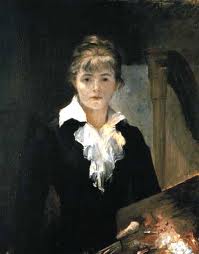
In her late teens, Marie Bashkirtseff wrote a letter to one Monsieur de M. Thus began a brief (Baskhirtseff died in 1884, shortly before her twenty-sixth birthday) but lively correspondence between the Ukraine-born mondaine and Guy de Maupassant.
Self-portrait of Marie Bashkirtseff

Only shortly before her death did Maupassant discover the identity of the correspondent who tells him in her first letter that she will always remain anonymous:
Monsieur,
I read you almost with happiness. You adore the truths of nature and find a truly great poetry in them, all while stirring us with details of feelings so deeply human that we recognize ourselves in them and love you with a selfish love. Is that a flowery remark? . . . Be forgiving—the essence is sincere.
I’d obviously like to say exquisite and striking things to you, but it’s very hard, just like that, right now. . . . I regret it all the more in that you are exceptional enough for a person to dream very romantically of becoming your beautiful heart’s confidante, if indeed your heart is beautiful.
If your heart isn’t beautiful and if you “aren’t into that sort of thing,” I regret it most of all for you and then I’ll call you a manufacturer of literature and that would be it.
It’s been a year now that I’ve been about to write you, but . . . several times I thought that I was overrating you and that it wasn’t worth it. When, all at once, two days ago, I read in the Gaulois that someone sent you a gracious letter and you ask for this good person’s address to answer him. . . . I got very jealous right away—your literary merits dazzled me again, and here I am.
Now, listen closely to me, I will always remain anonymous (really) and I don’t want even to see you from afar—who knows? I might not like your looks. I know only that you are young and that you aren’t married, two essential points even in the blue of the clouds.
But Ill have you know that I’m charming—this delightful thought will encourage you to answer me. It seems to me that if I were a man I would want no commerce, not even epistolary, with an old English hag, regardless of what might think
Miss Hastings.
R.D.G. (Bureau de la Madeleine)